Showing posts with label King County. Show all posts

Tuesday, August 26, 2014

Why preventing prescription drug abuse is important

Over the past week, a few posts focused on what coalitions can do to prevent teen medicine abuse.  Since I realize I may have put the cart before the horse, today's post will explain why preventing teen prescription painkiller abuse is important.  

Prescription medicine abuse is the intentional use of a medication without a prescription; in a way other than as prescribed; or for the experience or feeling it causes.  According to the National Institutes on Drug Abuse, the medications most commonly abused are pain relievers/opioids.  

Prescription opioids act on the brain like heroin does and can be highly addictive.  As a 2013 report on the problem in WA states, "For some, abuse of prescription-type opiates . . . leads to heroin use so preventing inappropriate use of prescription opiates is important." 

Abuse of opioids, alone or with other drugs including alcohol, can depress breathing and lead to death. In King County, the Poison Center reports that oxycodone and hydrocodone (both opiods) are the most common drugs mentioned in prescription drug-related overdose reports.  Prescription opiates and heroin are the top two causes of drug-related deaths in King County.  Since 2009, as prescription opiate-related deaths decreased heroin-related deaths increased.  

Source: Alcohol and Drug Abuse Institute's 2013 report on King County drug trends.  

Wednesday, July 9, 2014

King County drug abuse trends 2013


The annual King County Drug Trends report was released last month by the King County Drug Trends Workgroup.  Among their major findings is that heroin use continues to increase in King County and statewide; young adults are a major population of concern.  Heroin involved deaths among those under 30 has increased from 7 deaths (14%) in 2009 to 34 deaths (34%) in 2013, the numbers for all ages increased from 49 to 99 respectively.


The report includes information about drug treatment admissions and for adolescents (under 18 years old) marijuana remains the primary reason for entering treatment.  For young adults (under 30 years old) heroin is the primary reason for entering treatment and alcohol is the primary reason for all other adults. 

A complete copy of the report is available at http://adai.uw.edu/pubs/cewg/CEWG_Seattle_June2014.pdf.

Monday, October 7, 2013

County & City make comments about proposed marijuana rules

Last week, comments about proposed marijuana rules were submitted to the Liquor Control Board by King County and the Seattle City Attorney.

King County comments
Among their comments, King County recommended that the Liquor Control Board could strengthen their final rules by addressing:

"1) Preventing youth access and use (Preventing the distribution of marijuana to minors).  The priority can be addressed if the Board:

- Further strengthens packaging/labeling and accompanying materials language (including rotating health warnings) to ensure parents, other adults and youth understand health risks to youth and children, for both usable and infused marijuana products,

. . . - Limits advertising in a manner that is consistent with alcohol advertisement restrictions."  

". . . 3) Minimizing disproportionate siting and neighborhood impacts by avoiding siting of multiple businesses in close proximity to one another, with particular emphasis on equitable distribution of risks and benefits of legalization."

All King County comments may be read by clicking here.

Seattle City Attorney comments
While King County asked that the Liquor Control Board limit marijuana retail density, the Seattle City Attorney expressed concern that there will not be enough marijuana retail stores in Seattle.

". . . The one additional issue we want to highlight is ensuring that the number of licensed dispensers is sufficient to meet demand . . . we ask that the Board carefully monitor supply and demand for recreational marijuana as soon as the licensed dispensers begin sales and consider issuing additional licenses later in 2014 for dispensers in Seattle if the 21 initial licenses are insufficient to meet demand in our city."

Seattle City Council ordinance
Later today, the Seattle City Council will once again take up an ordinance regarding where marijuana businesses may be located in Seattle.  The proposed ordinance would restrict marijuana businesses to large commercial and industrial areas, excluding historical districts.  Combined with Liquor Control Board rules requiring a 1,000 foot buffer between marijuana businesses and schools, playgrounds, and other places where minors congregate, potential places for marijuana businesses to be located are rather limited in Seattle.    Areas dense with marijuana businesses may be unavoidable.

Public hearing
The Liquor Control Board is hosting a public hearing about their proposed rules tomorrow, October 8, 6-9:00 p.m. at Seattle City Hall.

Wednesday, June 26, 2013

King County expresses concern about marijuana business density


The King County Law, Justice, Health and Human Services Committee met yesterday and an update about the implementation of I-502 was on their agenda.  Here are a few items discussed:

  • King County is in the process of establishing a “one-stop” webpage for all marijuana-related information.
  • Concerns were expressed re: zoning in unincorporated King County.  Joe McDermott is concerned about marijuana business density in White Center and others are concerned about marijuana business density in rural areas.  It is expected that King County will propose zoning legislation to address these concerns on or around August 15.  They are waiting to see what the LCB rules end up saying about land use and zoning.  They will include a map of how different areas of the county will likely be affected.
  • The Sheriff said that his officers are enforcing the no public consumption law but Seattle Police are not. 


Discussion about I-502 starts around 1:24:00. 


Get Adobe Flash player

Friday, April 13, 2012

4/20 and youth marijuana use


According to CADCA, coalitions are “re-mixing” what “420” means to youth, changing the perception that marijuana is not harmful, and are re-claiming April 20th from an unofficial marijuana smokers’ “holiday.”

In observance of 4/20, I thought I'd post some Washington State data about youth marijuana use.

Access vs. Use
While Washington State 10th and 12th graders say that marijuana is as easy to get as alcohol, alcohol use among high school students remains higher than marijuana use.  Legal, regulated alcohol is used at higher rates than marijuana.  (2010 Washington State Healthy Youth Survey)


Youth Drug Use Trends
Over the past six years, underage drinking and tobacco use rates have declined while youth marijuana use rates have increased.  (Washington State Healthy Youth Survey)


Perception of Risk
Over the past few years, fewer youth report that marijuana use is risky.  As the chart of national data below shows, when perception of risk decreases, use increases.  Some people speculate that the national debate about medical marijuana and marijuana legalization has contributed to this decline in perceived risk.


Youth Treatment & Marijuana
Though alcohol is the #1 drug used by youth, marijuana is the #1 reason youth enter treatment.  This differs from adults, who enter treatment primarily for alcohol-related problems.    


Sources of data:


Wednesday, March 23, 2011

What teenagers think adults think about youth alcohol, tobacco and marijuana use


These charts show the percent of King County and Washington State 6th, 8th, 10th, and 12th grade students who report that adults in their neighborhoods think youth alcohol, tobacco, and marijuana use is "very wrong".  As you see, the older children get, the less likely they are to think adults disapprove of drug use.  

Source: 2010 Healthy Youth Survey.  King County results are posted on the Prevention WINS website.

Tuesday, March 22, 2011

Youth perceive risk of harm from tobacco and use it at lower rates than alcohol and marijuana


These charts show the percent of King County and Washington State students in grades 6, 8, 10 and 12 who report great risk of harm from using different substances.  (Source: 2010 Healthy Youth Survey -- HYS.)  Results from the 2010 HYS also show that tobacco use rates among youth are much lower than the rates of youth alcohol and marijuana use.

Monday, March 21, 2011

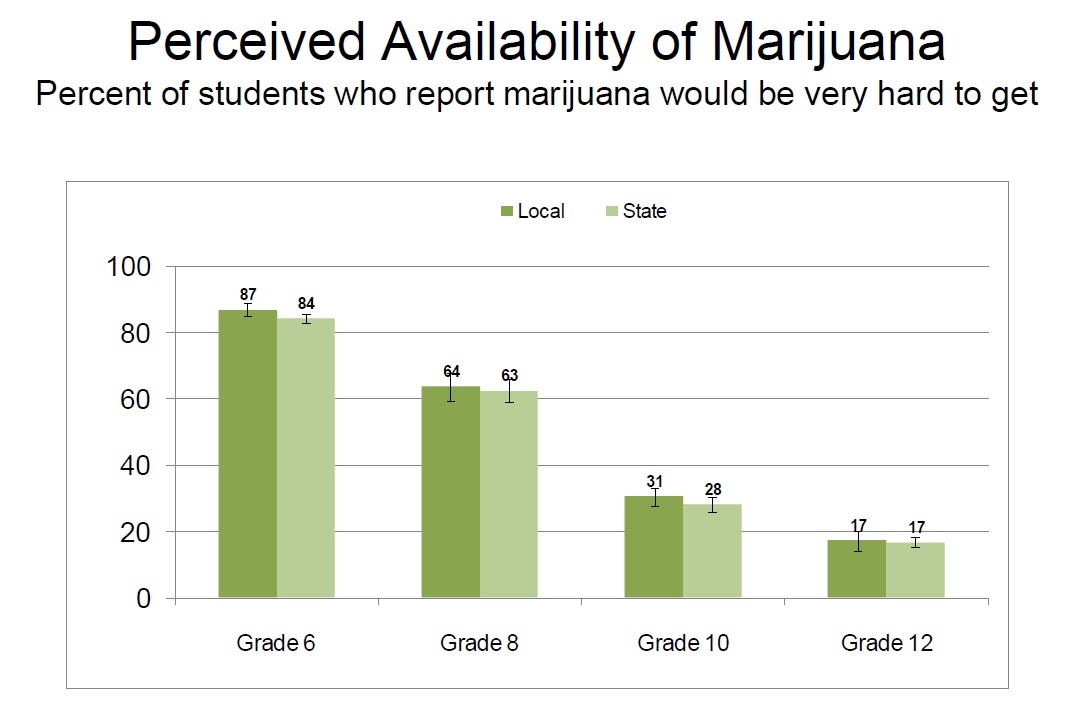
Teenagers find it easy to get alcohol


State and King County results from the 2010 Healthy Youth Survey (HYS) were recently released.  Among the questions that students in grades 6, 8, 10 and 12 were asked is how difficult it would be to get alcohol, cigarettes and marijuana.  As is shown in the charts above,  perceived availability declines significantly for all substances as children get older.  HYS results also show that adolescents find it easier to get alcohol and cigarettes, both legal and regulated, than it is to get marijuana.